Your business is already using AI. The question is whether you're doing it safely.
Let me be direct with you.
I've spent over 30 years building and securing IT infrastructure for some of the most regulated industries in the country -- healthcare networks, law firms, automotive enterprise. I've written the mandated annual HIPAA compliance reports. I've worked two real cyber incidents: one a network breach, one a financial fraud forensics case. Both in Los Angeles. Both avoidable.
So when I see a small business owner open ChatGPT and paste in a client's medical history to "summarize the intake notes" -- I don't see productivity. I see a HIPAA incident that hasn't been discovered yet.
That's not a scare tactic. That's pattern recognition.
The problem with how most businesses adopt AI
Most businesses don't choose how they adopt AI. They drift into it.
Someone on the team starts using ChatGPT. It's fast, it's free, it's useful. Then someone else. Then it's everywhere -- and nobody's asked the question that actually matters: where is our data going?
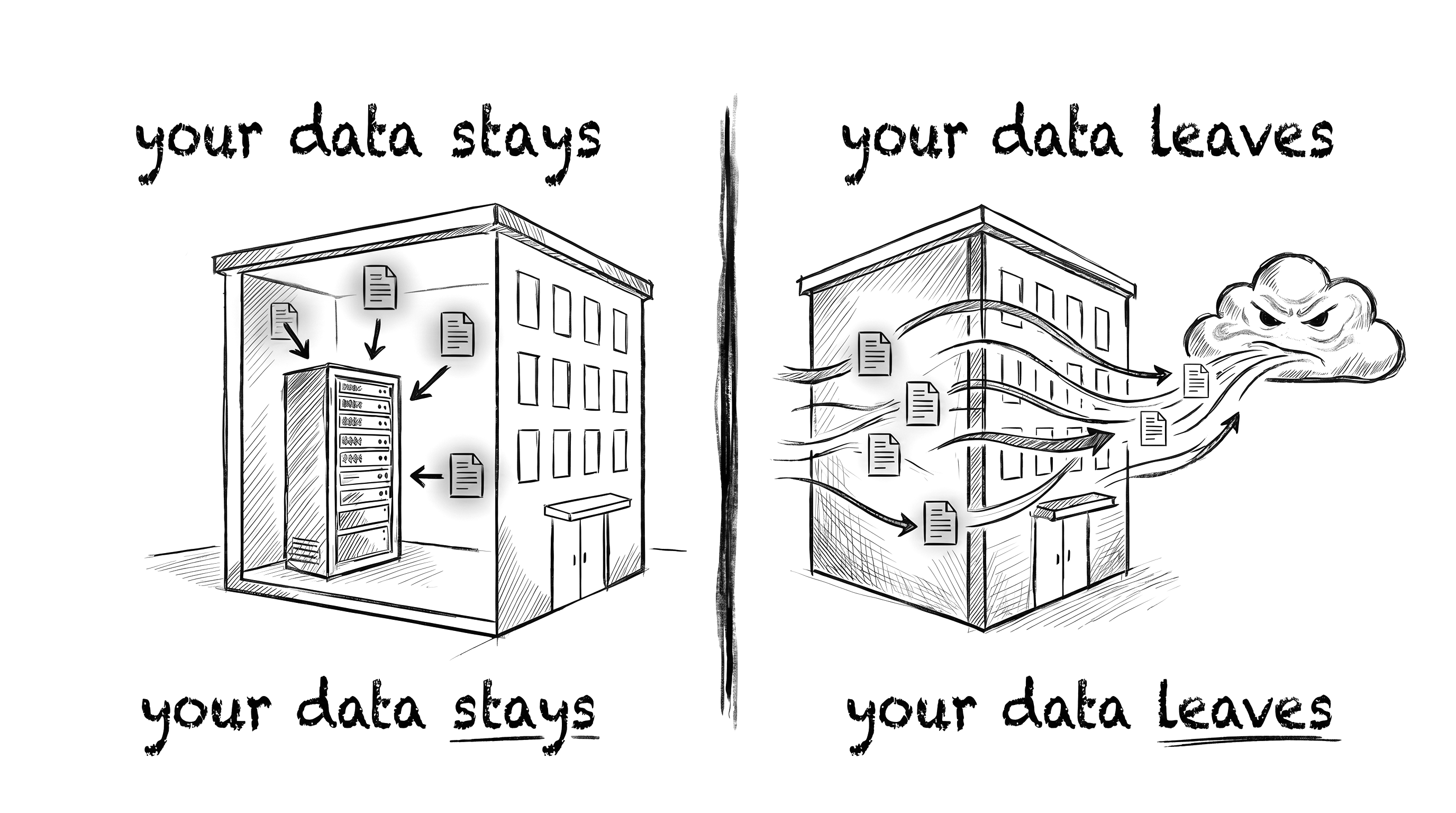
The answer, when you're using consumer AI tools, is simple: out the door. Onto someone else's servers. Processed by systems governed by terms of service you clicked through without reading. Potentially used to train the next version of the model.
For a general interest search or a personal email? Fine. For a law firm's privileged client communications? For a healthcare practice's patient records? That's not a gray area. That's liability.
There are three levels. Most businesses are stuck at Level 1.
Level 1 -- Consumer AI: The Default
This is ChatGPT, Microsoft Copilot, the free tier of whatever tool someone found online. Fast, easy, capable. And completely outside your control the moment you hit send.
If you're using it for anything that doesn't touch sensitive data -- personal productivity, general research, brainstorming -- it's fine. The problem is that "sensitive data" has a habit of creeping in once a tool feels indispensable.
Level 2 -- Private LLM: The Operator
This is where I spend most of my time with clients. A capable language model running on your hardware, in your building, on your network. Nothing leaves. No vendor has access. No terms of service that quietly claim rights to your data.
This is not exotic technology. I'm deploying these systems right now for small healthcare practices and legal offices in Los Angeles. The models are mature. The infrastructure is manageable. And when configured correctly, it's fully HIPAA-compatible -- something no consumer AI tool can claim.
Level 3 -- Agentic AI: The Architect
This is the frontier. Not the dangerous kind -- the strategic kind.
A private LLM connected to your actual data: your case files, your patient records, your internal documentation. It surfaces what you need. It flags what you're missing. In a well-designed system, it drafts the compliance documentation automatically.
This is where small businesses can build a genuine competitive advantage -- not by using the same tools as everyone else, but by deploying intelligence that runs on their data, for their context, with their rules.
Why most people get this wrong
The conversation about AI in business has been dominated by two camps: the evangelists who want you to automate everything immediately, and the skeptics who think the whole thing is a fad.
Both are wrong, and both are unhelpful.
The reality is more like what I've seen in every technology transition over the past three decades: the businesses that win aren't the ones who move fastest or slowest. They're the ones who understand what they're actually deploying -- the architecture, the risks, the leverage points -- and make deliberate choices.
That's what this channel is about. Not hype. Not hand-wringing. The actual mechanics, from someone who's been inside these systems.
Where to start
If you're a business owner reading this and you've got people on your team using AI tools -- the first question to ask isn't "how do we use more AI?" It's: do we know where our data is going right now?
If the answer is no, that's your starting point.
If you want to understand what a private AI deployment looks like for a business your size, that's exactly what I cover. Start with the infographic. Then come back here -- there's a lot more to unpack.
Chris Rondthaler is a Strategic Technologist and MSP owner based in Los Angeles. He builds private AI infrastructure for healthcare, legal, and security-conscious businesses that can't afford to get this wrong.